
| Mexico 1968: What Really Happened When Two Americans Raised Their Fists Deirdre van Dyk - TIME | |
| go to original July 25, 2012 |
 |
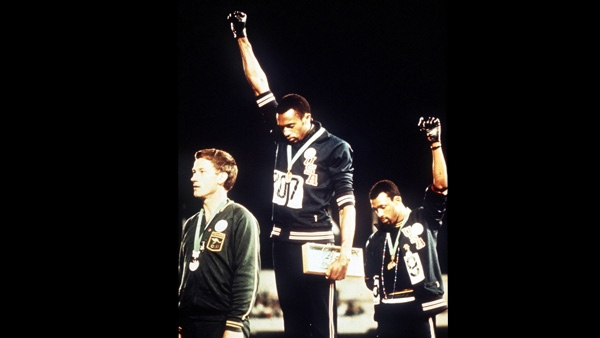
1968 Olympic Games, Mexico City, Mexico, Men's 200 Metres Final, USA gold medallist Tommie Smith and bronze medallist John Carlos give the black power salutes as an anti-racial protest as they stand on the podium with Australian silver medallist Peter Norman.
At the 1968 Olympics in Mexico City, after African-American sprinters Tommie Smith and John Carlos won gold and bronze, respectively, in the 200-meters, the two runners stood atop the podium with medals around their necks. As the Star-Spangled Banner played, white Australian silver medalist Peter Norman stared ahead, while the two Americans bowed their heads and each lifted a fist, covered in black leather, creating one of the most famous, and controversial, images in sports history. “I thought it had a deal of humanity in the way it was done,” wrote BBC commentator Barry Davies, who was covering his first games. “It wasn’t in any way extrovert or flamboyant, it was a quiet holding aloft of the arm with the black glove.”
Yet that wasn’t how most of the media, the public or the Olympic committee viewed it. “Angrier, nastier, uglier better describes the scene,” said TIME. Labeled “ungrateful,” “disaffected,” “petulant” and “petty,” the two Americans were kicked off the U.S. team and given 48 hours to leave the country. The Australian press skewered Norman for his complicity, and he was denied a chance to compete for Australia in future Olympics.
Four decades later, what really happened on the podium, and afterwards, is detailed in a new documentary, Salute, by Matt Norman, Peter’s son. The fists were not a spontaneous gesture, but carefully planned. It was not a Black Panther tribute, but a show of solidarity with all oppressed people. Norman was not an oblivious bystander, but an active participant. It was, says Matt, a moment that would cost all three men their careers.
The stakes were high at the 1968 Olympics. They were the first Games to be broadcast in color to an audience of 600 million worldwide. Before the start, Mexico City had been the scene of violence - a crowd of 6,000 anti-government protesters in Mexico City’s central square were cut down by the military. A 60-year old woman was bayoneted in the back; a 13-year old boy was shot at close range. “Once More with Violence” read a TIME headline about the slaughter of over 30 people and wounding of hundreds more. “Games in Trouble,” declared Sports Illustrated. The year had seen the Tet Offensive, riots during the Chicago Democratic convention, the Prague Spring and the assassination of both Robert Kennedy and Martin Luther King, Jr. The athletes were not immune to the events erupting around them. By organizing the Olympic Project for Human Rights (OPHR), a number of athletes wanted to make a stand against oppression, not just in the US, but around the world.
International Olympic Committee president Avery Brundage insisted that athletes refrain from making political gestures. Knowing the OPHR was planning something, Brundage, a controversial figure who, despite cries for a boycott, had pushed for America’s participation in the 1936 Nazi Olympics in Berlin, sent in Jesse Owens to talk to athletic activists. Owens was shouted down. “We felt sorry for him actually,” recalled 400-meter sprinter Lee Evans.
As the eyes of the world were on them, Smith, Carlos and and Norman headed out to the field for the medal ceremony. Carlos realized he had forgotten his glove. “My father suggested they share Smith’s pair and each wear one,” says Matt. Peter also asked the Americans for an OPHR badge to wear to show his respect for what they were about to do. What you can’t clearly see in the photo is that the Americans were also shoeless, to symbolize poverty. Carlos wore beads, and Smith a black scarf, around their necks to symbolize the lynchings that were taking place in the American South.
The crowd grew angry, which surprised the three athletes. “I threw my arm up, and said ‘Please, God, get me out of here,’” recalls Smith.
Smith and Carlos returned to the U.S. and struggled to find work. Carlos’s wife eventually committed suicide: Carlos blamed it on the condemnations and media attacks. Despite the years of working manual labor and feeling ostracized, Carlos says he would do it again. “I didn’t like the way the world was, and I believe there need to be some changes in the way the world is,” Carlos wrote in The John Carlos Story.
“I was on a world stage, implementing a need for human actions,” said Smith recently on a UK news show. “People were sedentary in their lives, not realizing the need for a coalition of understanding.” Norman agreed. “It has been said that sharing my silver medal with that incident on the victory dais detracted from my performance,” says Norman, in Salute. “On the contrary, I was rather proud to be a part of it.”
We invite you to add your charity or supporting organizations' news stories and coming events to PVAngels so we can share them with the world. Do it now!
Celebrate a Healthy Lifestyle
 From activities like hiking, swimming, bike riding and yoga, to restaurants offering healthy menus, Vallarta-Nayarit is the ideal place to continue - or start - your healthy lifestyle routine.
 Banderas Bay offers 34 miles of incomparable coastline in the states of Jalisco and Nayarit, and home to Puerto Vallarta and Riviera Nayarit's many great destinations.