
| 2015 Is Shaping Up as the Year of Anti-Corruption for Latin America Shannon K. O'Neil - Council on Foreign Relations | |
| go to original September 13, 2015 |
 |
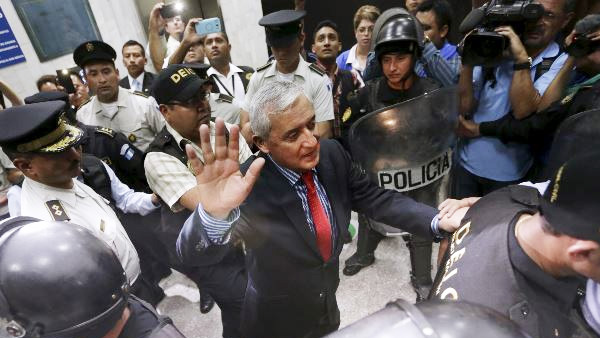
Guatemala's former President Otto Perez Molina gestures while being escorted by police officers after a hearing at the Supreme Court of Justice in Guatemala City, September 3, 2015. Perez resigned his presidency and turned himself in to a court on Thursday to face charges in a corruption scandal that gutted his government and plunged the country into chaos days before a presidential election. Congress, in an emergency session, approved the resignation of Perez, a 64-year-old retired general who quit overnight. Vice President Alejandro Maldonado will fill out the remaining months of Perez' term (Jorge Dan Lopez/Reuters).
After resigning last week in the face of a growing corruption scandal, Guatemalan President Pérez Molina now faces trial and potentially jail. Investigations into government corruption have disrupted politics as usual in Brazil, Chile, and Mexico, while scandals continue to unfold in Argentina and Panama.
The Dickens quote “it was the best of times, it was the worst of times” is perhaps too dramatic, but differences in how the cases are playing out across the region are quite striking. In Brazil and Guatemala, wide-ranging investigations have led to prosecutions and convictions of many of the nations’ most connected political and economic elites. In contrast, in Mexico, President Peña Nieto, the first lady, and the finance minister were recently cleared of conflict of interest allegations, and in Chile, President Bachelet’s son, Sebastián Dávalos, has so far evaded criminal charges in an influence-peddling scheme.
The divergent outcomes are due in part to the differing nature of the alleged crimes. In Brazil and Guatemala, officials are charged with embezzling public funds. Through the use of wiretaps, email monitoring, and financial forensics, Brazilian prosecutors traced the flows of hundreds of millions of dollars that private companies overcharged the state-led energy company Petrobras for construction and service work, and then distributed among themselves and into political party coffers. And the Guatemalan president and the vice president are accused of running a customs fraud operation, pocketing tens of millions of dollars in import duties.
The Chilean and Mexican cases on the other hand are about profiting from political access. In Chile, Caval, a company half-owned by Bachelet’s daughter-in-law, received a $10 million loan from Andronico Luksic through his Bank of Chile the day after Bachelet was reelected president. Her daughter-in-law and son then used the money to flip real estate, using insider information to buy land that was expected to quickly soar in value when the local government reclassified it for commercial development - reaping $5 million in profit. In Mexico, the president, first lady, and finance minister purchased homes from Grupo Higa, a construction conglomerate awarded hundreds of millions of dollars in public works contracts. The alleged links in both cases between favorable financial terms and political favors - and wrongdoing - are more difficult to prove than the embezzlement schemes.
Read the rest at Council on Foreign Relations
Related: Corruption in Latin America and Marijuana Legalization: The Case of Ex-President Molina (The Huffington Post)
We invite you to add your charity or supporting organizations' news stories and coming events to PVAngels so we can share them with the world. Do it now!
Celebrate a Healthy Lifestyle
 From activities like hiking, swimming, bike riding and yoga, to restaurants offering healthy menus, Vallarta-Nayarit is the ideal place to continue - or start - your healthy lifestyle routine.
 Banderas Bay offers 34 miles of incomparable coastline in the states of Jalisco and Nayarit, and home to Puerto Vallarta and Riviera Nayarit's many great destinations.