
| Militia Forces in Mexico: Citizens' Security or Further Conflict Escalation? Vanda Felbab-Brown - Insight Crime | |
| go to original December 30, 2015 |
 |
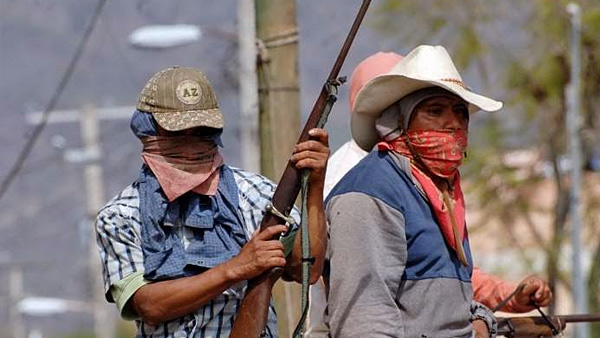
This article explores the security and political effects of militia forces that emerged in Mexico in recent years in reaction to violent organized crime, most prominently in the states of Michoacan and Guerrero.
The home state of former Mexican president Felipe Calderon, Michocan was an early focus of his administration in response to the rapid growth of the violent criminal cartel La Familia Michoacana (LFM). In 2006, LFM was one of Mexico's most vicious drug trafficking groups, and its authority was expanding over large parts of the state, particularly in La Tierra Caliente. It engaged in brutal violence, visible on the streets of Michoacan. It launched an aggressive extortion campaign that targeted major businesses in the state, such as avocado growers and logging companies - not even businesses operating in the state capital of Morelia were immune. By 2009, LFM reportedly had influence over (or extorted anyway) perhaps as many as 180,000 sales outlets, including gasoline stations, truck shops, street markets, movie theaters, and other businesses. Its daily earnings were reported (likely highly exaggerated) to be USD $1.9 million.
La Familia's control over some communities was pervasive. LFM would monitor the entries and exits of towns and villages, permitting or denying passage to anyone passing through, sometimes extorting the person for money. Mixing religion and rituals under a cultish cloak, it also established "courts" and "dispute resolution" procedures for residents of areas under its influence. Indeed, some residents of Michoacan's Tierra Caliente as well as Morelia told me in spring 2011 that they actively preferred the courts of La Familia to the formal state justice. Others were just terrified, believing that the group had "halcones" (lookouts and informants) everywhere; had deeply penetrated mayors' offices, municipal councils, and local police forces; and could strike anyone. But La Familia also had to battle other criminal groups for turf, including the super-violent and expanding Los Zetas as well as smaller rivals, such as the Millenio Cartel. Over time, government action combined with these attacks from rivals hastened the demise of La Familia.
During the Calderon administration, Michoacan became one of the first areas where the Mexican military was deployed to combat criminal groups. Like elsewhere in Mexico, one of the military's key missions was to back up, and in some circumstances completely replace, Michoacan's municipal police forces which typically were undertrained, under-resourced, deeply corrupt, and completely overwhelmed by organized crime.
Equally important, the new military policing strategy - consisting of high-value targeting and searches at fixed checkpoints - failed to restore or, perhaps more precisely, expand state authority and control. Nonetheless, the high-value targeting strategy was capturing many of LFM's top leaders; and in the spring of 2011, Los Piños (the seat of the Mexican president) declared LFM dismantled.
By then, the militias were arresting people whom they accused of working for the Templarios and other criminal groups, and held their own court trials and meted out sentences.
Within weeks, however, a new criminal group, Los Caballeros Templarios (Knights Templar), emerged and took over the illegal and informal markets in Michoacan that La Familia used to run. Although portraying themselves as a self-defense force to protect Michoacan residents and purge the area of organized crime, Los Templarios soon came to behave like the evil they purported to ostracize. Even more aggressively than LFM, they extorted legal, informal, and illegal businesses. In addition to kidnapping relatives of rich businessmen, they, too, demanded extortion fees from avocado farmers and logging companies, and expanded the extortion racket into iron ore extraction and shipping through Michoacan's principal port and economic hub, Lazaro Cardenas. In March 2014, the Mexican government's special envoy for restoring rule of law in Michoacan, Alfredo Castillo, claimed that Los Templarios made more of their money from extorting the iron ore extraction, processing, and transshipment operations than from drug smuggling or other extortion.
Regardless of whether this assessment of the cartel's financial portfolio is accurate, the Templarios, exploiting their strong territorial presence and a fearsome reputation, succeeded in turning themselves into a multi-faceted mafia with fingers in many illegal rackets in the state and widespread extortion.
Read the rest at Insight Crime
This is an excerpt from an article that was originally published by the Center for Complex Operations in the security studies journal PRISM. Read the full article here.
Photo: Mexico Gulf Reporter
We invite you to add your charity or supporting organizations' news stories and coming events to PVAngels so we can share them with the world. Do it now!
Celebrate a Healthy Lifestyle
 From activities like hiking, swimming, bike riding and yoga, to restaurants offering healthy menus, Vallarta-Nayarit is the ideal place to continue - or start - your healthy lifestyle routine.
 Banderas Bay offers 34 miles of incomparable coastline in the states of Jalisco and Nayarit, and home to Puerto Vallarta and Riviera Nayarit's many great destinations.