
| Forensic Justice: State of Jalisco's Surprising Answer to Crime-Lab Corruption Meghan Walsh - Ozy | |
| go to original January 10, 2016 |
 |
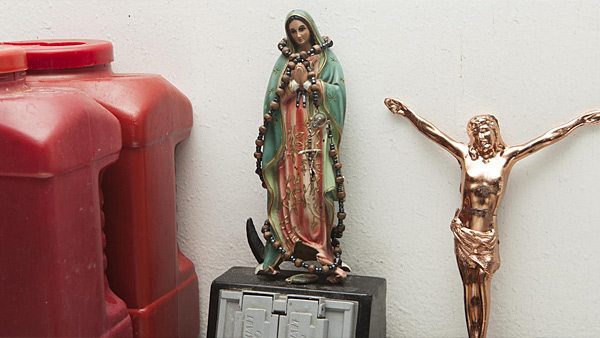
The IJCF's autopsy room is nearly bare, except for several religious mementos. (Alex Washburn/OZY)
Except for a single wooden crucifix hanging from a nail, the crime lab’s morgue looks antiseptic, with stark white walls and silver-railed beds. I’ve been there for less than an hour when the medical examiner wheels in a body encased in wet garbage bags. With help, he hoists the mass onto a stainless steel body tray, and immediately, the crew goes to work, cutting the plastic away, one layer at a time, the way a child carefully pries the wrapping paper from a birthday present. It appears the victim, a late-20s male, was beaten, suffocated and then dumped in a canal. The cartels call these corpses regalos, or gifts.
A handful of plain-clothed investigators hover while the forensics workers dutifully collect evidence: snapping pictures, snipping hair samples, swiping under fingernails. The lead detective voices her displeasure that I’m here, but the guys in the lab coats just smile. She can stomp her feet all she wants, but this forensics lab, in Guadalajara, isn’t police turf. The son of God peers down from above; the badge has no jurisdiction here.
Elsewhere in Mexico and in all of the United States, forensics falls under the strong hand of law enforcement. On the never-ending reel of CSI shows, agents dust for fingerprints in one scene and pull out the handcuffs in the next. Here in the midwestern state of Jalisco, it’s different. Specially trained civilians do the DNA testing, while police must keep their distance. It might sound like little more than a bureaucratic nuance, but this small detail packs a decent amount of reform. And it’s a model that has found purchase north of the border, as crime labs continuously come under new scrutiny for their dysfunction and the toll of botched convictions notches ever higher.
In Jalisco, home to the cartel that last spring shot down a military helicopter with an RPG, venality runs deep and the violence is heinous: corpses cut to pieces, fingerprints burned away with acid, bodies stacked on top of bodies. Indeed, as the narco wars have reached new depths, it’s been hard to see any light through the blood and despair. But 18 years ago, amid recalcitrant corruption, officials decided to partition forensics from police and prosecutors, giving the Instituto Jalisciense de Ciencias Forenses complete autonomy. Independence, they believed, would prevent conflicts of interest, promote scientific integrity and restore public trust.
Sure enough, since the reorganization, the institute has become a beacon of pride, doing what others in Washington, D.C., and around the world haven’t been able to. Less certain is whether America, in the age of criminal-justice reform, is finally ready to take a few cues from its southern neighbor.
Read the rest at Ozy
We invite you to add your charity or supporting organizations' news stories and coming events to PVAngels so we can share them with the world. Do it now!
Celebrate a Healthy Lifestyle
 From activities like hiking, swimming, bike riding and yoga, to restaurants offering healthy menus, Vallarta-Nayarit is the ideal place to continue - or start - your healthy lifestyle routine.
 Banderas Bay offers 34 miles of incomparable coastline in the states of Jalisco and Nayarit, and home to Puerto Vallarta and Riviera Nayarit's many great destinations.