
| Use of Armed Forces in Drug War a 'Mistake' Says Mexico Military Chief Elise Ditta - InSight Crime | |
| go to original March 16, 2016 |
 |
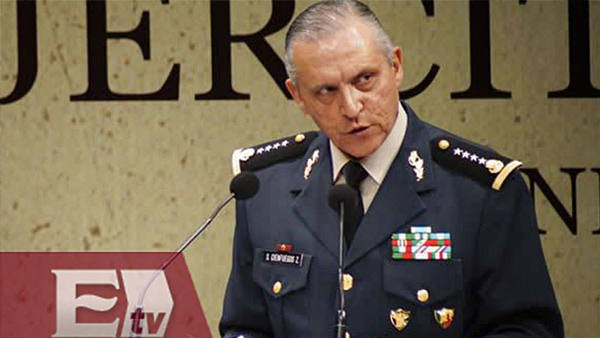
The commander of Mexico's armed forces has said it was a mistake to deploy the country's military to combat drug trafficking in comments heavily critical of the citizen security militarization policies that have become common in the region.
In an interview with Pulso, the head of Mexico's National Defense Secretariat (Sedena), General Salvador Cienfuegos Zepeda, said it had been wrong for the Mexican military to "enter fully into combat against drug traffickers," which, he said, left the military with "a problem that is not ours."
Cienfuegos said that sending "soldiers prepared for war" to confront criminals with no military training has caused "serious problems," and admitted that tactics such as day time raids have left the civilian population at risk.
The general added he believes the army should not be deployed in the streets for the purpose of combatting crime as they are not prepared for the role.
"Not one of the people with responsibility for this institution is prepared to carry out the functions of the police," he said. "We don't do that. We don't ask for it. We have no taste for it and we are not comfortable in this role."
However, Cienfuegos said, corruption in the police force meant that "if we don't do it, there is no one else who will."
The general also defended the military against accusations of human rights abuses in the emblematic cases of the military's alleged mass execution of 15 people in the town of Tlatlaya in June 2014, and accusations of armed forces' complicity in the disappearance of 43 students in the town of Iguala in September 2014.
Cienfuegos noted that four soldiers have been released without charges in the Tlatlaya case, and three have yet to be tried. In the Iguala case, he stated that the armed forces have "absolutely no responsibility."
InSight Crime Analysis
The points raised by General Cienfuegos echo the concerns of human rights monitors over the trend towards militarization of citizen security in Latin America. While using soldiers in the fight against crime can be an attractive option in the short term, it often leads to an increase in human rights abuses, while taking resources and momentum away from police reform.
In Mexico, the military has been accused of a range of abuses, including excessive force, extrajudicial killings, torture and disappearances, and reports of these abuses have risen considerably since the military was deployed in the drug war, according to human rights groups Amnesty International and Human Rights Watch.
Despite these concerns, Mexico is far from alone in pursuing a military solution to its security crisis. Currently, El Salvador has deployed military units to fight the growing gang violence in the country, while Honduras has also significantly expanded the role of the military in citizen security. There is little sign of this trend reversing, and in 2016 Argentina's incoming president, Mauricio Macri, declared a public national security emergency that could open the way for the country to become the latest to militarize its anti-drug efforts.
See the original at InSight Crime
We invite you to add your charity or supporting organizations' news stories and coming events to PVAngels so we can share them with the world. Do it now!
Celebrate a Healthy Lifestyle
 From activities like hiking, swimming, bike riding and yoga, to restaurants offering healthy menus, Vallarta-Nayarit is the ideal place to continue - or start - your healthy lifestyle routine.
 Banderas Bay offers 34 miles of incomparable coastline in the states of Jalisco and Nayarit, and home to Puerto Vallarta and Riviera Nayarit's many great destinations.