
| Cautious Progress in Mexico: Citizens Are Heard in Preliminary Steps to End Corruption Briseida Valencia Soto - Council on Hemispheric Affairs | |
| go to original August 1, 2016 |
 |
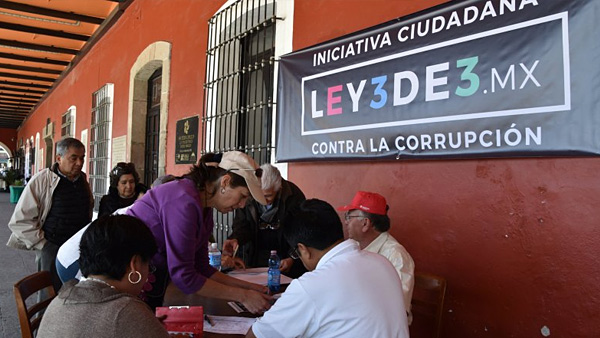
Mexican President Enrique Peña Nieto, who took office on December 1, 2012, has waned in his efforts to tackle corruption after previously having expressed his commitment to this goal. As a result, citizens are taking action into their own hands, proposing an anticorruption bill known as Ley 3de3 (3 out of 3). Peña Nieto’s party, the Institutional Revolutionary Party (PRI) has faced several electoral defeats during June’s state elections, but is now more willing to pass such progressive legislation - predominantly in an effort to increase PRI’s support in anticipation of the 2018 presidential elections.
Corruption, of which arguably every government is guilty, is especially prominent in Mexico. The most recent corruption percentage index provided by NGO Transparency International lists Mexico as 95th among 168 countries. Furthermore, a 2001 survey conducted by Encuesta Nacional de la Cultura Política (ENCUP) asked citizens what words came to mind when hearing the term “politics” - the most common response was “corruption.” Even Anthony DePalma, author and New York Times journalist, explained, “Corruption is not a characteristic of the system in Mexico ... it is the system.” Although corruption is embedded in everyday life in Mexico, this does not mean citizens are in favor of it. On the contrary, many citizens are now pressuring the government to tackle this epidemic, as evidenced by Ley 3de3.
Cost of Corruption
Research by the Institute for Economics and Peace reports on how much the drug war has cost Mexico. (CCTV America)
Adding to citizens’ negative views of corruption is its high cost. From bribery to embezzlement, corruption costs Mexico’s economy around $48 billion USD annually, or around eight times the annual budget for social programs. Furthermore, Transparency International revealed that, on average, households paid bribes in 10.3 of every 100 cases when accessing public services in 2010 - an increase from 10 in every 100 cases in 2007. For the majority of citizens who live in poverty, accessing public services becomes an economic hassle that they cannot afford. Instead, the money spent facilitating corruption should be used to fund social programs in order to decrease poverty and inequality, two of Mexico’s other endemic problems.
White House Scandal
The Mexican media has been successful in exposing government scandals, further painting President Peña Nieto and his cabinet as corrupt. The most controversial case, called the “White House scandal,” occurred in late 2014. Well-known Mexican journalist Carmen Aristegui reported that the president lived in a luxurious home, which he had not reported as part of his assets. As investigations continued, it was revealed that the house was registered under the name of an influential government contractor who allegedly bought the house on behalf of the president’s wife, Angélica Rivera. When the property’s value, reportedly about 86 billion pesos or $4.6 million USD, was revealed, doubts arose as to whether the couple could afford such a home on a presidential salary.
To download a PDF version of this article, click here
Read the rest at Council on Hemispheric Affairs
Photo: Ley3de3.mx
We invite you to add your charity or supporting organizations' news stories and coming events to PVAngels so we can share them with the world. Do it now!
Celebrate a Healthy Lifestyle
 From activities like hiking, swimming, bike riding and yoga, to restaurants offering healthy menus, Vallarta-Nayarit is the ideal place to continue - or start - your healthy lifestyle routine.
 Banderas Bay offers 34 miles of incomparable coastline in the states of Jalisco and Nayarit, and home to Puerto Vallarta and Riviera Nayarit's many great destinations.