
| Where Is Mexico Going? The Obstacles in Its Rocky Road to Democracy Roderic Ai Camp - Oxford Research | |
| go to original September 22, 2016 |
 |
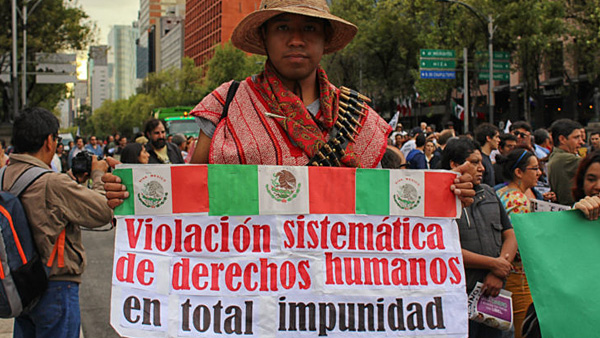
“Marcha #RenunciaYa” (ProtoplasmaKid/Flickr)
In a recently released poll this month, 22% of Mexicans approved of President Enrique Peña Nieto’s performance in office. Data released in the same survey revealed that 55%, more than twice the percentage of those who viewed the president in a positive light, strongly disapproved of his performance. No president since Vicente Fox, who was elected in 2000 and moved Mexico significantly along the path to electoral democracy, has ever received such weak support. When ordinary citizens were asked to identify those policy areas where Peña Nieto’s administration was perceived as performing least effectively, they identified the following: a mere seven percent viewed the government’s approach to drug trafficking in positive terms; between 10% to 12% of Mexicans ranked the administration’s efforts in reducing crime, hunger, and poverty as successful; and only 13% to 14% viewed its foreign policy, environmental, and anti-corruption efforts as successful.
Mexico achieved a major change in its political structure at the end of the 20th century, shifting from a semi-authoritarian model dominated by a single political organization, the Institutional Revolutionary Party (PRI), to a competitive, functional three party system in the 2000 presidential election, when, for the first time since the 1920s, an opposition candidate from the National Action Party (PAN) won the election. The next two elections reinforced the growth and legitimacy of electoral competition, when in 2006 a second PAN candidate, Felipe Calderón, defeated the candidate of the Party of the Democratic Revolution (PRD), Andrés Manuel López Obrador, with PRI’s candidate finishing third in the race. To the surprise of many observers, PRI made a significant comeback in the 2012 race to defeat López Obrador, while the PAN candidate finished a distant third.
No president in the past three elections has won a majority of the votes. Unbeknownst to the public, the presidents of these three leading parties, along with the current president of Mexico, negotiated and signed an innovative policy agreement known as the Pact for Mexico, which identified all of the major policy issues and the legislative changes necessary to address them. Each of the party leaders acknowledged that none had a clear governing mandate. The Pact was an extraordinary attempt to decrease partisanship in the legislative branch, and to create an imaginative yet practical collaboration among the three major political organizations. It allowed all parties simultaneously to take credit for the policies passed by the Chamber of Deputies and implemented by the federal government.
Given this extraordinary achievement, many observers believed early on that Peña Nieto might be able to create the necessary changes to push Mexico further on its path toward a consolidated democracy: that is, a democratic political model that, among other characteristics - including competitive elections and turnover among the incumbent political parties - would strengthen transparency, accountability, and the rule of law. Although this agreement lasted only 14 months, the administration was able to introduce and actually implement a number of significant policies. Some of those policies are linked to the three qualities that are necessary for a functional democratic system. For example, the government has made a number of alterations to the legal system, the most important of which was to shift a trial system based on a Napoleonic legal approach, relying heavily on confessions supplied by the prosecution, to a system more comparable to that found in the United States, where oral testimony and forensic evidenced are essential to a fair trial.
Despite these on-going changes, crime and corruption - both real and perceived - remain serious issues in Mexico. The federal government’s own data from the National Public Security System reveals that homicides, many of them drug related, increased significantly in 17 states since Peña Nieto was inaugurated in December 2012.
Read the rest at Oxford Research
We invite you to add your charity or supporting organizations' news stories and coming events to PVAngels so we can share them with the world. Do it now!
Celebrate a Healthy Lifestyle
 From activities like hiking, swimming, bike riding and yoga, to restaurants offering healthy menus, Vallarta-Nayarit is the ideal place to continue - or start - your healthy lifestyle routine.
 Banderas Bay offers 34 miles of incomparable coastline in the states of Jalisco and Nayarit, and home to Puerto Vallarta and Riviera Nayarit's many great destinations.