
| Did Drug Traffickers Funnel Millions of Dollars to Mexican President López Obrador’s First Campaign? Tim Golden - ProPublica | |
| go to original February 1, 2024 |
 |
Update: Mexican President Suggests Us Talks on Migration and Drugs May Suffer After Drug Money Allegations (Associated Press)
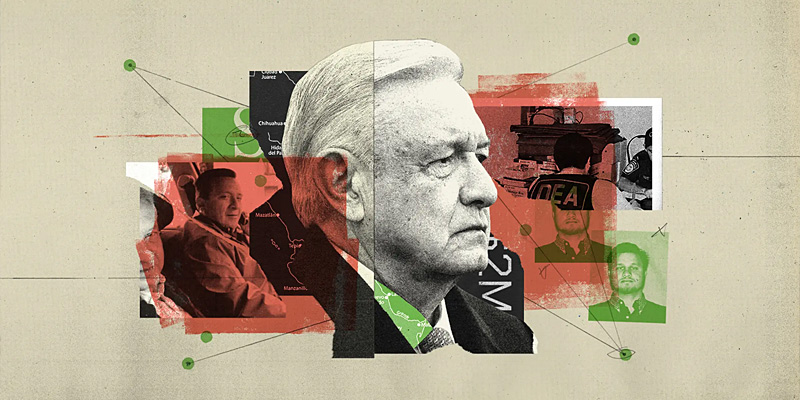
Years before Andrés Manuel López Obrador was elected as Mexico’s leader in 2018, U.S. drug-enforcement agents uncovered what they believed was substantial evidence that major cocaine traffickers had funneled some $2 million to his first presidential campaign.
According to more than a dozen interviews with U.S. and Mexican officials and government documents reviewed by ProPublica, the money was provided to campaign aides in 2006 in return for a promise that a López Obrador administration would facilitate the traffickers’ criminal operations.
The investigation did not establish whether López Obrador sanctioned or even knew of the traffickers’ reported donations. But officials said the inquiry — which was built on the extensive cooperation of a former campaign operative and a key drug informant — did produce evidence that one of López Obrador’s closest aides had agreed to the proposed arrangement.
The allegation that representatives of Mexico’s future president negotiated with notorious criminals has continued to reverberate among U.S. law-enforcement and foreign policy officials, who have long been skeptical of López Obrador’s commitment to take on drug traffickers.
The case raised difficult questions about how far the United States should go to confront the official corruption that has been essential to the emergence of Mexican drug traffickers as a global criminal force. While some officials argue that it is not the United States’ job to root out endemic corruption in Mexico, others say that efforts to fight organized crime and build the rule of law will be futile unless officials who protect the traffickers are held to account.
“The corruption is so much a part of the fabric of drug trafficking in Mexico that there’s no way you can pursue the drug traffickers without going after the politicians and the military and police officials who support them,” Raymond Donovan, who recently retired as the Drug Enforcement Administration’s operations chief, said in an interview.
In their investigation, DEA agents developed what they considered an extraordinary inside source after they arrested the former campaign operative on drug charges in 2010. To avoid federal prison, the operative gave a detailed account of the traffickers’ cash donations, which he said he helped deliver. He also surreptitiously recorded conversations with Nicolás Mollinedo Bastar, the close López Obrador aide who the operative said had participated in the scheme.
Along with the sworn statements of other witnesses, the taped conversations indicated that Mollinedo was aware of and involved in the donations by one of the country’s biggest drug mafias, current and former officials familiar with the case said.
But some officials felt the evidence was not strong enough to justify the risks of an extensive undercover operation inside Mexico. In late 2011, DEA agents proposed a sting in which they would offer $5 million in supposed drug money to operatives working on López Obrador’s second presidential campaign. Instead, Justice Department officials closed the investigation, in part over concerns that even a successful prosecution would be viewed by Mexicans as egregious American meddling in their politics.
“Nobody was trying to influence the election,” one official familiar with the investigation said. “But there was always a fear that López Obrador might back away on the drug fight — that if this guy becomes president, he could shut us down.”
Since taking office in December 2018, López Obrador has led a striking retreat in the drug fight. His approach, which he summarized in the campaign slogan “Hugs, not bullets,” has concentrated on social programs to attack the sources of criminality, rather than confrontation with the criminals.
Yet with police and military forces generally avoiding confrontation with the biggest drug gangs, those mafias have extended their influence across Mexico. By some estimates, criminal gangs dominate more than a quarter of the national territory — operating openly, imposing their will on local governments and often forcing the state and federal authorities to keep their distance. The violence has hovered near historic levels, while the gangs’ extortion rackets and other criminal enterprises have metastasized into every layer of the economy.
The Mexican president’s chief spokesperson, Jesús Ramírez Cuevas, did not respond to numerous requests for comment.
Read the rest at ProPublica
Related: ‘Operation Polanco’: How the DEA Investigated AMLO’s 2006-Presidential Campaign (InSight Crime)
Related: Mexican President AMLO Denies Allegations That Drug Cartels Funded His First Campaign (Semafor)
Related: Opinion: AMLO’s Grip on Power and Mexico’s Future at Stake (Mexico Institute/Wilson Center)
Related: High Incidence of Corruption by Authorities in Puerto Vallarta Reported (Vallarta Daily News)
We invite you to add your charity or supporting organizations' news stories and coming events to PVAngels so we can share them with the world. Do it now!
Celebrate a Healthy Lifestyle
 From activities like hiking, swimming, bike riding and yoga, to restaurants offering healthy menus, Vallarta-Nayarit is the ideal place to continue - or start - your healthy lifestyle routine.
 Banderas Bay offers 34 miles of incomparable coastline in the states of Jalisco and Nayarit, and home to Puerto Vallarta and Riviera Nayarit's many great destinations.