
| Makeover of Mexico City Moves Forward with Renovation of Roundabout Adriana Gomez Licon - Associated Press | |
| go to original December 28, 2012 |
 |
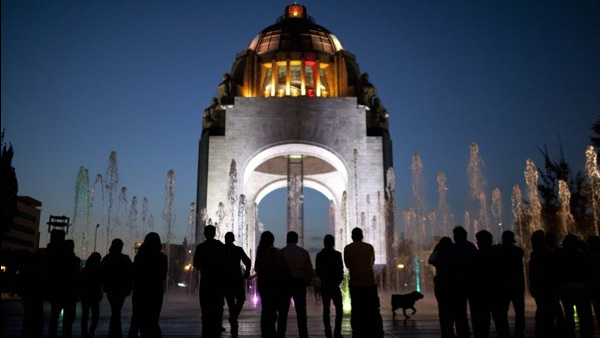
Pedestrians stand in front of the Arch of the Revolution monument in Mexico City, Wednesday, Dec. 26, 2012. The once-neglected plaza with an Arc de Triumph-style monument to Mexico’s 1910 revolution has been remade from a homeless encampment to a place where families visit and children run through spurts of water gushing out of the pavement. The copper dome of what started out as the congressional rotunda is newly polished and gleaming. (Alexandre Meneghini/Associated Press)
Mexico City’s government is trying to transform one of the world’s largest cities by beautifying public spaces, parks and monuments.
“Yes it’s safer, and it’s renovated, but what happens to the emblem of Mexico City?” said Baltazar Romeo, 47, a hospital worker eating a sandwich at the newly remodeled Alameda. Gone were the street performers who once dressed as the Three Wise Men during Christmas and charged tips for photos with children. “The city is becoming soulless,” Romeo said.
One of the flagship renovation projects is the once-seedy, swarming Glorieta de Insurgentes, a roundabout and metro station in central Mexico City that sees hundreds of thousands of commuters pour through every day.
The circular plaza was sunk to let pedestrians stream below busy thoroughfares and catch their trains or buses or just hang out. Around its rim careen cars in a roundabout that briefly merges two of the city’s biggest thoroughfares, the mighty Insurgentes and Chapultepec avenues.
When the plaza was built in 1969, the city’s top priority was moving an onslaught of cars and people from one point to another. Highways and beltways elsewhere went up to cope with the population boom, and sprawl spread farther out. Once-famous and safe streets and plazas suffered from neglect by planners and became slum-like neighborhoods people avoided after sunset. A brown haze covered the new skyline as motorists became the focus of the new infrastructure.
The Insurgentes roundabout turned into a place to hurry through. Homeless people took over abandoned warehouses nearby while surrounding office and apartment buildings fell into disrepair. Many of the plaza’s shops became sleazy Internet cafes cowering beneath giant billboards.
“It couldn’t be more hostile to public life or pedestrian life,” said Ken Greenberg, a Toronto-based architect and urban designer who recently visited Mexico. “The whole thing just has a kind of very harsh feeling of a highway right in the middle of the city.”
Urban designers are now seeking to infuse the chaos with the glitzy excitement of Times Square or London’s Piccadilly Circus. Sixty-foot cylinders covered with circular screens streaming LED tickers have already been erected. The crabgrass-filled flower beds and low benches used as skateboard launches have been bulldozed for a sleek open-air look bathed in white, patterned concrete.
The makeover is meant to create a more appealing space for commuters using bikes and public transit in a city that won infamy as the world’s most painful for commuters in a 2011 IBM survey.
“What Mexico City needs is to emphasize its identity through its public spaces,” Escotto said.
The government says the Insurgentes project will also debut a new model for restricting advertising to designated spots. In 2010, local government banned advertisements on all public and private buildings, threatening a $9,000 fine for those who refused to comply. Two years later, however, the city is still blanketed by billboards.
Future projects include a cleanup of 67 bridges around the city and more lighting for plazas and walkways throughout Chapultepec Park, Mexico City’s grand urban green space.
Some projects, including the Insurgentes roundabout, are being completed with the help of private funds. The roundabout renovation includes $4.5 million from 15 advertising companies that are erecting the giant LED screens. Critics worry the arrangement will benefit private companies more than city residents. Much of the beautification of the historic center was paid for by telecommunications billionaire Carlos Slim.
Some wonder whether Mancera, who is from Ebrard’s party, will continue the effort and whether the city has the money to maintain its improvements. The question for this teeming city is whether its attempt to clean up will hold or whether the sprawl will ultimately prove more powerful.
“How is this work going to look in the next five months, or five years?” asked De Leo Gandara of the Iberoamerican University. “Will they preserve it? Will it still be clean? Are they keeping it together or is it forgotten again?”
Adriana Gomez Licon is on Twitter: @agomezlicon
We invite you to add your charity or supporting organizations' news stories and coming events to PVAngels so we can share them with the world. Do it now!
Celebrate a Healthy Lifestyle
 From activities like hiking, swimming, bike riding and yoga, to restaurants offering healthy menus, Vallarta-Nayarit is the ideal place to continue - or start - your healthy lifestyle routine.
 Banderas Bay offers 34 miles of incomparable coastline in the states of Jalisco and Nayarit, and home to Puerto Vallarta and Riviera Nayarit's many great destinations.