
| You Say US Should Deport the Mexican Interlopers? But They've Been Here All Along Emily Chertoff - The Atlantic | |
| go to original January 31, 2013 |
 |
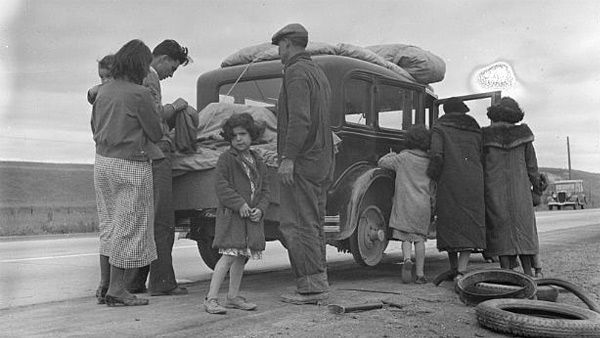
In this 1936 photo by Dorothea Lange, a family of migrant workers from Mexico has car trouble on a California road. (Library of Congress)
Mexicans don't necessarily have it the worst when crossing illegally into the United States. Ecuadorans and Salvadorans, who also immigrate here in large (and rising) numbers, tend to face a much longer land journey - they have to pass through all of Mexico to get here. The ocean crossing from Cuba to Key West, a mere 100 miles, may be the most dangerous of all, especially if you set out at night on a homemade raft, as many migrants used to do.
But Mexicans, even those traveling safely and legally between the two countries, carry history with them when they cross the border. On the drive past Nuevo Laredo to San Antonio or Houston - or at any number of checkpoints along the national border - they pass through land that used to be claimed by Mexico.
President Barack Obama and a bipartisan group of eight senators have proposed comprehensive immigration reform. If the measure passes, it will impact immigrants from around the world, but perhaps none more so than Mexicans. As Brian Resnick of National Journal notes, 55 to 60 percent of our undocumented immigrants are Mexican. That's about 6 million people, a far greater number than any other country has sent us.
At least publicly and at least so far, a lot of the objections to the plan have taken the law-and-order angle. What kind of message does it send to reward law-breakers with citizenship? But other objections are not as sophisticated. Commentators have begun to invoke the idea, long popular on the right, that legalizing our undocumented workers would somehow mock or weaken U.S. sovereignty.
At moments like this, it's good to remember that the border has been highly porous, and often ambiguous, for most of U.S. history. Mexicans and their forebears have lived on both sides of it for a long time. Because of the Mexican-American war, our economic ties, and our geopolitical situation, almost every Mexican citizen has some kind of history with the U.S. (The relationship is arguably Mexico's most fraught.)
Read the whole story at The Atlantic
Emily Chertoff writes for and produces The Atlantic's National channel.
We invite you to add your charity or supporting organizations' news stories and coming events to PVAngels so we can share them with the world. Do it now!
Celebrate a Healthy Lifestyle
 From activities like hiking, swimming, bike riding and yoga, to restaurants offering healthy menus, Vallarta-Nayarit is the ideal place to continue - or start - your healthy lifestyle routine.
 Banderas Bay offers 34 miles of incomparable coastline in the states of Jalisco and Nayarit, and home to Puerto Vallarta and Riviera Nayarit's many great destinations.