
| Year of the Kumatz: A Mayan Perspective on the Year of the Snake Jonah Harris - New America Media | |
| go to original February 16, 2013 |
 |
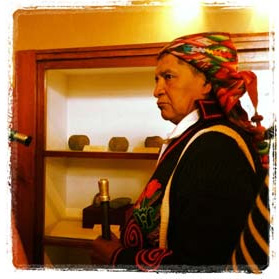 |
| Photo of Don Tomas Calvo (Mayanow.org) |
Last year, young couples across East Asia scrambled to get married and have babies in the auspicious Year of the Dragon. The same isn’t quite true of the current Lunar New Year, the Year of the Snake, which is being met with a more muted enthusiasm, due to the less favorable position held by the serpent (sometimes referred to as “little dragon”) in ancient Chinese culture.
Western culture, meanwhile, is downright unfriendly towards the animal. It was a snake, after all, that in the Bible convinced Eve to eat the forbidden fruit, inviting evil into the Garden of Eden. The western canon is rife with other examples of serpents representing deviousness and evil. From fairy tales to modern cartoons, the snake is a harbinger of bad luck - a creature to be feared.
Yet, as we embark on this Year of the Snake, solace can be found in the fact that there is at least one culture that views snakes in a more benevolent light. In the highlands of Guatemala, today's Mayan elders hold the serpent in high esteem.
Don Tomas Calvo is Nim Winaq, or high council, of the indigenous municipality of Santo Tomas Chichicastenango in the department of El Quiché, Guatemala. He is the moral and ancestral authority of the Mayan people, the guardian of the Popol Vuh, a Mayan holy book, and most likely the highest-ranked Mayan elder alive today. For his people, serpents are representatives of good.
"For our culture as Mayans," Don Tomas explains, "[the snake] is a creature of Mother Nature and guardian of the soil and earth. For us it does not represent anything satanic or bad, as it does in the western Catholic world, which mentions that the snake was used for evil to deceive Eve and cause her to eat the forbidden fruit and so deceive Adam so they were banished from paradise, whence the disobedience of original sin." Above all, he says, the snake represents justice.
In ancient times, Mayans would use snakes to help them reach a verdict, placing them among those suspected of committing an offense. According to Don Tomas, "The snake would always bite the guilty party." They could even take advantage of the biological diversity to impose a multilayered justice system. "My grandparents said that seeing a non-poisonous snake, this is a sign that we are doing something wrong," Don Tomas explains. "If we do not correct our path, the real poisonous snake will come." The non-poisonous snake is the toj, or warning. The poisonous snake is the kotzij, the execution of justice.
Read the whole story at New America Media
We invite you to add your charity or supporting organizations' news stories and coming events to PVAngels so we can share them with the world. Do it now!
Celebrate a Healthy Lifestyle
 From activities like hiking, swimming, bike riding and yoga, to restaurants offering healthy menus, Vallarta-Nayarit is the ideal place to continue - or start - your healthy lifestyle routine.
 Banderas Bay offers 34 miles of incomparable coastline in the states of Jalisco and Nayarit, and home to Puerto Vallarta and Riviera Nayarit's many great destinations.