
| Mexico Women Human Rights Defenders Denounce Lack of Protection for Their Work Gloria Letician DÃaz - Proceso | |
| go to original March 8, 2013 |
 |
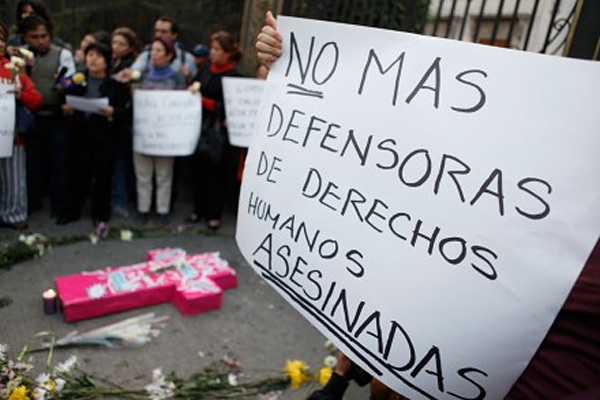
Sign reads: No More Assassinations of Human Rights Defenders (Marisela Escobedo)
MEXICO CITY - Human rights defenders denounced the lack of guarantees for performance of their work, which is visible in the increase of attacks on activists across the country, including homicide and forced disappearances.
Faced with the intent of reforms designed to weaken their agencies, such as the Inter-American Commission and Court of Human Rights, the advocates called on the government of Enrique Peña Nieto to support the Inter-American System of Human Rights. They issued their call at a press conference to commemorate International Women's Day.
Marusia López, of Just Associates, offered figures that show the [escalating] level of violence to which female defenders are exposed: from 2009 to 2011, twenty-six defenders were killed and four disappeared. In 2012, she added, there were sixty-four attacks, including defamation, threats, injuries and harassment.
According to López, the defenders who are exposed to human rights violations are, above all, those who report abuses committed by members of the Mexican Army as well as those involved in defense of the territory against mega-projects or mineral extraction, or the installation of wind farm projects, especially in cases registered in Oaxaca.
On the risk list are also defenders of femicide cases, especially those that claim a lack of investigation; additionally, are those defenders who focus their work on the defense of women's sexual and reproductive rights. Recent cases of violence against defenders have been recorded in Guanajuato and Jalisco, the activist reported.
Obtilia Eugenio Manuel, leader of the Organization of Indigenous Me pháa (OPIM), reported that despite preventive measures ordered by the Inter-American Court of Human Rights (IACHR) in 2009, the death threats against her do not stop. The last one occurred on February 5, she said.
Eugenio Manuel attributed the threats against her to the opposition headed by OPIM since 1998 against militarization in the indigenous region of Ayutla, Guerrero, and for [OPIM's] demand that the sentences by the CoIDH [Office of the High Commissioner for Human Rights in Mexico] in the cases of the indigenous Valentina Rosendo Cantú and Inés Fernández Ortega, who were raped by members of the Mexican Army in 2002, be carried out.
"What good is it to celebrate International Women's Day (March 8) if you don't know when they are going to kill us?" asked Obtilia, who claimed that so far none of the more than fifteen criminal charges that OPIM members have lodged for various offenses, including killings of indigenous advocates, have been resolved.
Imelda Marrufo, of the Red Table Network of Women in Ciudad Juárez, said that in addition to the threats that have forced defenders into exile, and cases of extreme violence, including the killing of Josefina Reyes, "there is a strategy to discredit the work of those who seek justice in cases of femicide and disappeared women."
She explained that smear campaigns are in full swing, at a time when the rise of femicide has exceeded in worrisome ways the levels seen twenty years ago, when the alarm of gender crimes was sounded.
On behalf of dozens of social organizations, the advocates announced their support of the Nobel Women's Initiative, signed by the women laureates and promoted by the Center for Justice and International Law (CEJIL), which has asked the governments of the countries in the Americas to prevent the weakening of the Inter-American System of Human Rights.
Stephanie Brewer, from the Agustín Pro Juarez Human Rights Center (PRODH Center), stressed the importance of strengthening human rights mechanisms that have promoted legislative reforms in accordance with the human rights of women, and the establishment of public policies that avoid repetition of human rights violations in compliance with provisions of the Inter-American Convention for the Prevention, Punishment and Eradication of Violence Against Women.
In turn, Cristina Hardaga noted that the risk that the Inter-American System might be weakened impacts women defenders, as the CIDH [Inter-American Commission of Human Rights] has pronounced in favor of precautionary measures that allow them to perform their work in light of their specific [high risk] cases.
In that sense, Gabriel Soto, director of Rapporteurs of the Human Rights Commission of the Federal District (CDHDF), added that given the nature of women defenders, who are usually mothers, when it is necessary remove them from their place of origin for security, it is required that the defender go with all her relatives, a situation that is not covered by local instruments, but that is made possible with an order of the Commission or the Inter-American Court.
Soto explained that it is urgent for the defenders to maintain current the instruments of the human rights system of the Organization of American States (OAS), given the level of day-to-day risk that they face, and he revealed that according to CDHDF reports, in the first two months of 2013, thirty-two activists reported attacks, a figure five times higher than that recorded for the first two months of last year.
See Spanish original
Posted by Jane Brundage at Mexico Voices
We invite you to add your charity or supporting organizations' news stories and coming events to PVAngels so we can share them with the world. Do it now!
Celebrate a Healthy Lifestyle
 From activities like hiking, swimming, bike riding and yoga, to restaurants offering healthy menus, Vallarta-Nayarit is the ideal place to continue - or start - your healthy lifestyle routine.
 Banderas Bay offers 34 miles of incomparable coastline in the states of Jalisco and Nayarit, and home to Puerto Vallarta and Riviera Nayarit's many great destinations.