
| Efforts in Mexico to Provide Health Services to LatAm Migrants Face Major Obstacles Alexandra McAnarney - Upside Down World | |
| go to original May 31, 2013 |
 |
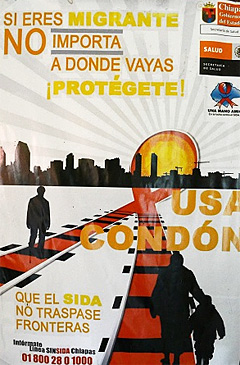 |
... Since 2007, HIV and AIDS rates have gone up throughout rural Mexican states, partly as a result of returning migrants who have engaged in high-risk behaviors in the United States and not been able to receive diagnosis or treatment. Medical experts are shifting their attention to the particular dangers faced by Central American migrants - human trafficking, sexual abuse, prostitution, isolation, depression, and drug use - as vectors driving these numbers, especially in the southernmost state of Chiapas, where 40,000 to 60,000 migrants cross through in the hope of finding a better life in Mexico or the United States.
According to the most recent report by the National Center for the Prevention and Control of HIV/AIDS (CENSIDA), Chiapas is the sixth state for highest accumulated AIDS cases with a registered 6,717 individuals living with the disease. Within the state, Tuxtla Guttierrez, Tonalá, Cintalapa and Tapachula were labeled “red flags” (Focos Rojos’) - municipalities where rates of infection and the presence of at-risk groups, like sex workers and increasingly migrants, are statistically higher than the rest of the state. Tapachula, where an estimated 95% of transiting migrants pass through, registered a total of 2,045 HIV-cases and has drawn the attention of local organizations, health groups, and migrant shelters.
Led by the charismatic Rev. Florencio Maria Rigoni of the Scalabrini Order of Missionaries, the Belen migrant shelter sits a few meters away from the brackish banks of the Cahoacan River and only 20 miles away from the Mexico-Guatemala border. The shelter’s orange and electric blue walls houses one of the starting gates for a multi-actor health response seeking to stem HIV-transmission rates.
These efforts begin from a modest 200 square foot office, where Dr. Ramos, his wife Leni Pundt and brother Victor Ramos offer free, voluntary medical services every Monday through Saturday afternoon to the shelter’s transient inhabitants. On Monday and Thursday, Dr. Ramos, a semi-retired general practitioner with a dead-pan sense of humor and a thick head of pewter hair, gives his HIV-prevention talks in the shelter’s mess hall with the help of graphic flip-boards and Pinocchio, a varnished wooden penis sporting plastic Mickey Mouse-style gloves, baby blue clown shoes, googly eyes and a condom as a hat.
“[Girls] would see a dildo and get embarrassed and leave,” the doctor explains. “Even the boys sometimes.”
Tact and humor, he believes, are the best medicines. But combined with the story of Juan - which always draws strong reactions from the crowd - he drives home an effective point: if you want to make your American Dream a reality, protect yourself and get tested.
Read the rest at Upside Down World
We invite you to add your charity or supporting organizations' news stories and coming events to PVAngels so we can share them with the world. Do it now!
Celebrate a Healthy Lifestyle
 From activities like hiking, swimming, bike riding and yoga, to restaurants offering healthy menus, Vallarta-Nayarit is the ideal place to continue - or start - your healthy lifestyle routine.
 Banderas Bay offers 34 miles of incomparable coastline in the states of Jalisco and Nayarit, and home to Puerto Vallarta and Riviera Nayarit's many great destinations.