
| In Famed Riviera Nayarit, Tourism Edges Out Community Maya Piedra - Global Press Mexico | |
| go to original February 22, 2022 |
 |
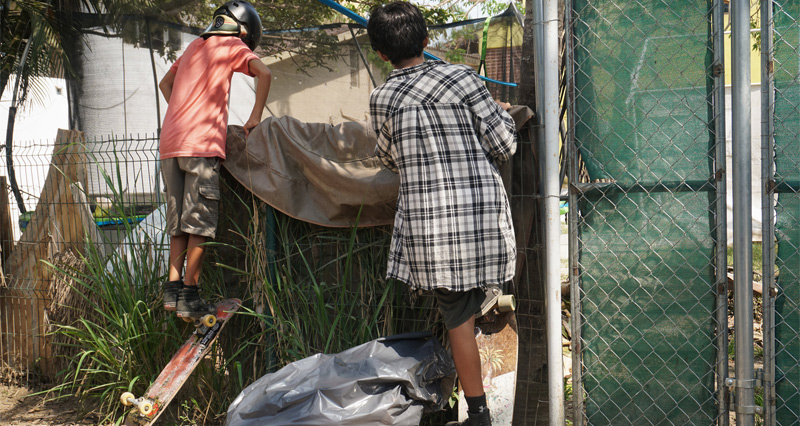

Children look over a fence at a small, private skate park where they’re sometimes allowed to skate — though on this day, no one is there to let them in. (Maya Piedra/Global Press Mexico)
At sunset, the children of Sayulita go to the central plaza to skate. Amid the colorful houses, restaurants and souvenir shops, swerving through laughing tourists, the skaters try to stake their ground. They practice tricks and play on the pavement of this small town on the Pacific coast of Mexico.
But in the midst of the recreational opportunities for adults and tourists, there is little space left for the children of Sayulita to play.
Community members say that tourism has fomented a process of urbanization and development that focuses on spaces and services for tourists — and neglects community, recreational and educational spaces for residents.
Institutions like La Casa de la Cultura (The Culture House), La Casa del Maestro (The Teacher’s House) and La Casa Campesina (The Farming House) once hosted community events, workshops, classes and more. Along with a section of the town’s graveyard, these cultural institutions have all become residences, hotels and restaurants that primarily serve tourists.
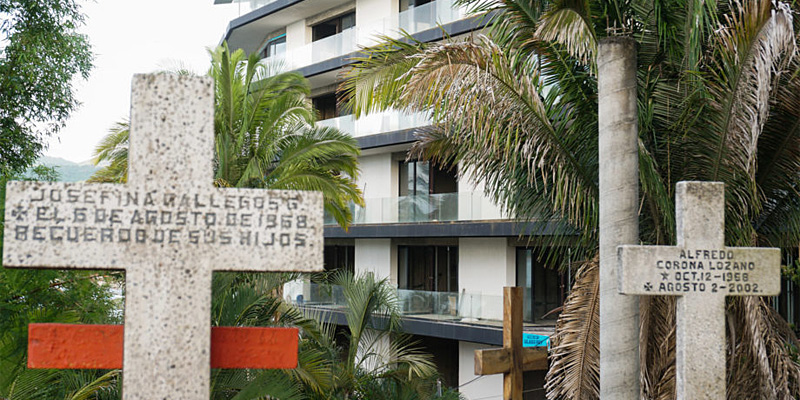
Around the cemetery in Sayulita, the ongoing construction of two hotels is visible (Maya Piedra/Global Press Mexico)
Tourists, cars, restaurants, bars, shops and vendors cram the streets of Sayulita, Nayarit. From 2009 to 2019, the state saw an increase of more than 1 million tourists.
In this shift toward a tourism economy, younger residents have felt the blow. “There are hardly any spaces for kids,” Matthew, 11, says. “It’s not fair that there are cantinas and bars on every corner,” adds Obed, 13.
In 2000, the Mexican state of Nayarit, where Sayulita is located in the municipality of Bahía de Banderas, established a tourist corridor in the south of the territory, rebranding an area that extends about 180 kilometers (112 miles) along the Pacific Ocean as the Riviera Nayarit.
Since then, Sayulita has become one of the Riviera’s main tourist destinations. In 2015, the town was incorporated into the Pueblos Mágicos (Magic Towns) program by the federal government, an initiative to invest in the infrastructure of major tourist destinations.
In 2009, 1.7 million tourists visited Nayarit, according to the Ministry of Tourism. That number nearly doubled in 2019, with 3.1 million visitors. In Sayulita alone, there are more than 300 rooms available on Airbnb, a popular online marketplace for lodging.
While an economic opportunity for some, the amount of housing for the general population has fallen, according to an August 2020 study published by professors at the Technological University of Bahía de Banderas and the University of Guadalajara.
As Sayulita urbanized, the estuary disappeared, and orchards and natural areas filled with trash. Insecurity increased, with robberies, drug trafficking, assaults and other violence on the rise, residents say.
According to the Executive Secretariat of the National Public Security System, intentional homicides in Bahía de Banderas more than tripled, from eight in 2015 to 27 in 2021. Incidents of sexual violence increased from 28 in 2015 to 41 in 2021.
Neither the Bahía de Banderas Tourism Office nor the Sayulita Police Commission responded to multiple requests for comment.
Read the rest at Global Press Mexico

We invite you to add your charity or supporting organizations' news stories and coming events to PVAngels so we can share them with the world. Do it now!
From the Bay & Beyond
Celebrate a Healthy Lifestyle
 From activities like hiking, swimming, bike riding and yoga, to restaurants offering healthy menus, Vallarta-Nayarit is the ideal place to continue - or start - your healthy lifestyle routine.
 Banderas Bay offers 34 miles of incomparable coastline in the states of Jalisco and Nayarit, and home to Puerto Vallarta and Riviera Nayarit's many great destinations.