
| Pricey Tortillas: Mexico’s Poor Struggle to Afford Staples Fabiola Sanchez - Associated Press | |
| go to original May 14, 2022 |
 |
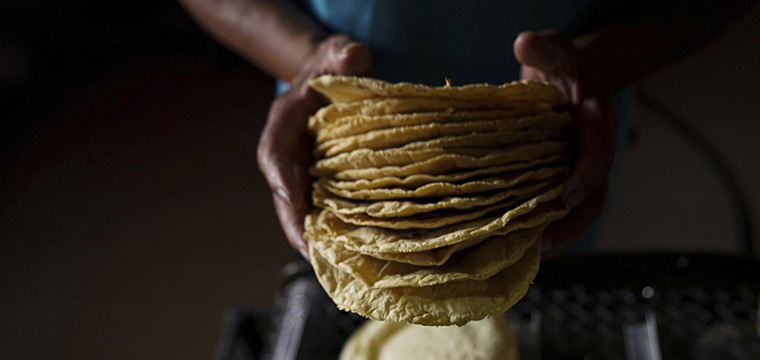
No item is more essential to Mexican dinner tables than the corn tortilla. But the burst of inflation that is engulfing Latin America and the rest of the world means that people like Alicia García, a cleaner at a restaurant in Mexico City, have had to cut back.
Months ago, García, 67, would buy a stack of tortillas weighing several kilograms to take home to her family every day. Now, her salary doesn’t go so far, and she’s limiting herself to just one kilogram (2.2 pounds).
“Everything has gone up here,” she told The Associated Press while standing outside a tortilla shop. “How am I, earning minimum wage, supposed to afford it?”
Just as inflation isn’t limited to tortillas, whose prices in the capital have soared by one-third in the past year, Mexico is hardly alone. Latin America’s sharpest price spike in a generation has left many widely consumed local products suddenly hard to attain. Ordinary people are reckoning with day-to-day life that has become a more painful struggle, without any relief in sight.
Countries had already been absorbing higher prices because of supply chain bottlenecks related to the COVID-19 pandemic and government stimulus programs. Then Russia’s invasion of Ukraine in late February sent fertilizer prices sharply higher, affecting the cost of agricultural products including corn. Global fuel prices jumped, too, making items transported by truck to cities from the countryside costlier.

How this family survives on a plastic trash dump hidden below a volcano in Guatemala (VERSE)
In Chile, annual inflation was 10.5% in April, the first time in 28 years the index has hit double digits. Colombia’s rate reached 9.2%, its highest level in more than two decades. In Argentina, whose consumers have coped with double-digit inflation for years, price increases reach 58%, the most in three decades.
In beef-crazy Buenos Aires, some households have started seeking alternatives to that staple.
“We never bought pork before; now, we buy it weekly and use it to make stew,” Marcelo Gandulfo, a 56-year-old private security guard, said after leaving a butcher’s shop in the middle-class neighborhood of Almagro. “It’s quite a bit cheaper, so it makes a difference.”
Last year, the average Argentine consumed less than 50 kilograms of beef for the first time since annual data were first collected in 1958, according to the Argentine Beef Promotion Institute. Over the past few months, prices have been “increasing a lot more than normal,” said Daniel Candia, a 36-year-old butcher.
“I’ve been in this business for 16 years, and this is the first time I’ve seen anything like this,” he said.
Latin America as a whole is suffering from “sudden price spikes for necessities,” the World Bank’s President David Malpass said during an online conference Thursday. He noted that energy, food and fertilizer prices are rising at a pace unseen in many years.
Read the rest at WPRI.com
Related: Mexico to Waive Import Duties on Food Staples as Inflation Bites (Just Food)
 Learn about Vallarta Food Bank
We invite you to add your charity or supporting organizations' news stories and coming events to PVAngels so we can share them with the world. Do it now!
From the Bay & Beyond
Celebrate a Healthy Lifestyle
 From activities like hiking, swimming, bike riding and yoga, to restaurants offering healthy menus, Vallarta-Nayarit is the ideal place to continue - or start - your healthy lifestyle routine.
 Banderas Bay offers 34 miles of incomparable coastline in the states of Jalisco and Nayarit, and home to Puerto Vallarta and Riviera Nayarit's many great destinations.