
| How a Tiny Town in Jalisco Became a Mecca in Western Mexico John Pint - Mexico News Daily | |
| go to original July 2, 2022 |
 |
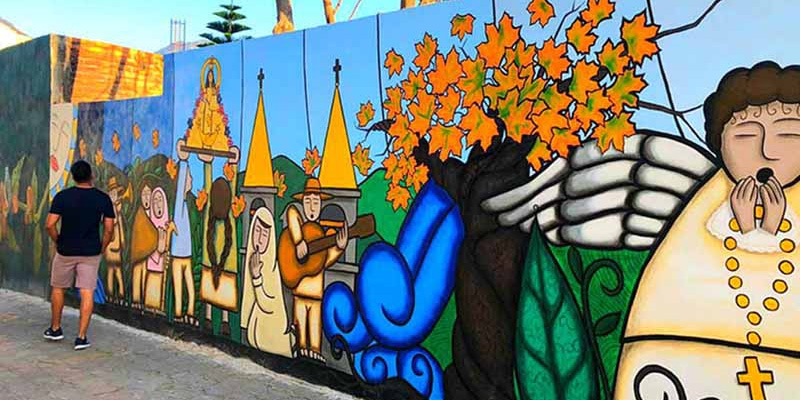

Mural in Talpa focusing on the religious processions. (Viajero sin Rumbo)
If the small town of Talpa de Allende, Jalisco, is not in the middle of nowhere, it is just on the edge of it, hidden among the lonely hills of the Sierra Occidental, about two-thirds of the way from Guadalajara to Puerto Vallarta.
Nevertheless, three million people go out of their way to visit tiny Talpa every year and a great many of them do it on foot.
Most of these visitors are peregrinos (pilgrims), many who hope to receive a blessing or perhaps even a miracle from a statue about 30 centimeters tall known as the Virgen del Rosario (the virgin of the rosary).
This statue was brought to Talpa in 1585 by the indigenous Tarasco people. Made of cornstalk paste, the monument held up well until 1644, when, “worm-eaten, rotting, broken and disfigured,” it was about to be buried, as is the custom for disposing of these religious statues when their useful life has come to an end.
At that moment, though, says the legend, “a resplendent light burst forth from the image,” knocking out the “undertaker.” When calm was restored, it was discovered that the little Virgin, too, had been restored to her former beauty in the twinkling of an eye and the flash of a heavenly light. Ever since then, say devotees, the miracles have just kept coming.
Many who walk all or part of the pilgrims’ route are devoted to the virgencita, but many others are there simply for the camaraderie that inevitably develops among Mexicans away from home — or they simply would like to say, “I did it! I walked all the way!”
The most popular path by far to Talpa is the 117-kilometer trail that starts in the town of Ameca, located 70 km west of Guadalajara. This route has some long, flat stretches running through oak forests, pastures and scrublands but also includes two particularly steep mountains: El Cerro del Obispo (The bishop’s hill) and the aptly named Espinazo del Diablo (the devil’s backbone).
Read the rest at Mexico News Daily

We invite you to add your charity or supporting organizations' news stories and coming events to PVAngels so we can share them with the world. Do it now!
From the Bay & Beyond
Celebrate a Healthy Lifestyle
 From activities like hiking, swimming, bike riding and yoga, to restaurants offering healthy menus, Vallarta-Nayarit is the ideal place to continue - or start - your healthy lifestyle routine.
 Banderas Bay offers 34 miles of incomparable coastline in the states of Jalisco and Nayarit, and home to Puerto Vallarta and Riviera Nayarit's many great destinations.