
| Let It Bee: The Women on a Mission to Save CDMX Bees The Associated Press | |
| go to original June 20, 2023 |
 |
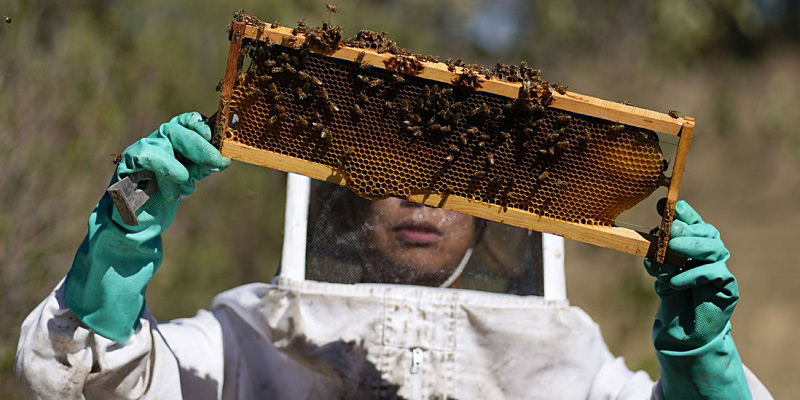

Adriana Veliz searches for the queen bee from the most recent group of bees rescued by the SOS Abeja Negra organization, in Xochimilco, Mexico. “We do these rescues because it’s a species that’s in danger of extinction,” said Velíz. (Eduardo Verdugo/AP)
"Knife," Adriana Veliz says with the concentration of a brain surgeon.
Shrouded in a white bee suit, she lies stretched out on the ground in one of Mexico City's most buzzing districts. Taking the knife, she pries open the side of a light post and flashes a glowing red lantern on a humming bee hive.
Veliz is on a mission to save the approximately 20,000 bees inside.
She heads a group of mostly women who are working hive by hive to relocate bees that would be exterminated if they remained in Mexico's crowded capital city.
 The group, Abeja Negra SOS, was born in 2018 when Veliz - a veterinarian working for the city government at the time - noticed that when authorities received calls about beehives, the automatic response was to exterminate the bees.
She and other colleagues began looking for an alternative.
"We do these rescues because it's a species that's in danger of extinction," said Veliz, who works for Abeja Negra SOS. "We're an alternative so that the emergency teams don't exterminate them. We give them a second chance."
Globally, bee populations have been decimated in recent decades. The United States alone is estimated to have lost around 25% of its bees in the past 40 years. Earlier this year, beekeepers in southern Mexico mourned the "mass killing" of millions of bees by pesticides.
The drop is often blamed on human causes: the use of damaging chemicals, destruction of natural habitats and climate change. Scientists and world leaders warn that bee population decline could have a wide range of detrimental ripple effects.
In 2019, the United Nations raised an alarm that bee loss "poses a serious threat" to global food security. Others like Adriana Correa Benitez, a professor researching bees at National Autonomous University of Mexico, said loss of bees could make it more difficult for Mexico to mitigate climate change.
"They don't just pollinate what we eat," she said. "They also pollinate native plants that regulate the entire ecosystem. And now, with climate change, reforestation is so important and (bee pollination) really influences that."
Over the past five years, the group has travelled across the sprawling city of 9 million, saving bee colonies from trees, street gutters and lamp posts. They have relocated around 510 hives, with an average size of about 80,000 bees.
Read the rest at CTVNews
Related: Urban Beekeeping Can’t Save the Bees, New Research Finds (CTVNews)
Related: Wild Bees Face Heightened Environmental Challenges in Cities: Canadian Study (CTVNews)

We invite you to add your charity or supporting organizations' news stories and coming events to PVAngels so we can share them with the world. Do it now!
From the Bay & Beyond
Celebrate a Healthy Lifestyle
 From activities like hiking, swimming, bike riding and yoga, to restaurants offering healthy menus, Vallarta-Nayarit is the ideal place to continue - or start - your healthy lifestyle routine.
 Banderas Bay offers 34 miles of incomparable coastline in the states of Jalisco and Nayarit, and home to Puerto Vallarta and Riviera Nayarit's many great destinations.